What is Active Matter?
Active matter systems are composed of energy consuming constituent components which drive the system to behave in very complex ways. These active materials have characteristic properties that are dramatically different from the everyday materials that we interact with; such as plastics, metals, or fluids such as water and oil. Endowing the fundamental unit of a material with the ability to consume energy, exert a force, or to move, can release the constraints of equilibrium statistical mechanics. The result can be a material that has properties of self-motility, self-healing, internally generated flows, or synchronous dynamics.
|
Birds are active matter!
A classic example of an active matter system is a flock of birds. A flock is composed of thousands of individual birds (such as Starlings shown in the video) which act autonomously. Each bird is consuming its own on-board energy supply in order to move. Despite the fact that each bird is able to fly independent of the other birds, the collection of birds maintains a coherent, amorphous shape. Notice that a flock executes turning maneuvers in unison. |
|
While birds are intelligent animals, it turns out the rules which govern bird flocking can be described by a few simple physical interactions… enter the physicists. Surprisingly, many of the beautiful, collective bird flock dynamics that are observed in nature can be described by the way in which birds interact with their neighbors. To be more specific, it has been found that birds preferentially align only with 6 or 7 of the nearest neighboring birds. From this simple rule, flocking, as seen in nature, is possible.
It is the goal of active matter physics to discover and characterize the rules which govern complex behavior in active matter systems.
|
Ciliary fields like the one shown on this paramecium are also found in your airway. They assist the removal of mucus from the lungs by acting as a conveyor belt.
|
Birds are not the only active matter around. All of life as we know it is active matter. Biological stuff runs on and is built by energy consuming particles working in unison. If you were to spill open one of the 100,000-billion cells which make up your body, you would find a stew of proteins, fibers, membranes, and genetic material. Many of these components consume the body’s fuel source, adenosine triphosphate (ATP), in order replicate, store information, or even move. Because of this active bio-machinery, our muscles can contract, our skin can heal, and you can cough up mucus. Check out this video which shows cilia on a paramecium. Similar ciliary fields exist in our trachea in order to remove mucus and contaminants from our lungs.
|
More recently, small organisms, such as bacteria or algae, have been studied to learn about the physics of active matter systems. Bacteria can flock on the micro-scale when there is a swarm of bacteria sufficiently dense so that they interact by swimming and bumping in to one another. The bacteria, which have an elongated rod-like body, will align with their neighbor and result in a nematic flock. Other organisms, such as volvox, can hydrodynamically couple to their neighbor into a bound state in which they swim together in a waltz-like dance. An individual microorganism moves autonomously in response to its environment, but the physical interactions between organisms controls higher order collective motions. They are truly governed by the laws of physics.
|
E coli bacteria can exhibit collective motion. They align and even swarm in dense suspensions. Video: Matthew Copeland, University of Wisconsin, Madison via Youtube.
|
Volvox is a colony of algae which can hydrodynamically couple with neighbors resulting in a waltz-like dance. Video: Raymond Goldstein Lab via Youtube.
|
Model Active Matter!
|
The most insightful experiment is one which you can control. Biological systems contain the inherent complexity of life and are therefore difficult to tune, test, and tweak in the laboratory setting. In order to research active matter physics, some researchers have been looking for model active matter systems which can be easily experimentally studied. This means that the system should be robustly repeatable, highly tunable, and live long enough for the duration of an experiment. One such approach is to make synthetic active matter systems in the lab.
One possibility has been explored by researchers at Harvard University by making self-propelled machines out of vibrating motors and toothbrush bristles (called Bristlebot). These experiments have been studying the collective dynamics of swarms of the robotic Bristlebots and exemplify how very simple interactions (robots bumping into eachother) can lead to very complicated collective behavior. Another approach pursued by researchers at NYU is to create tiny, self-propelled particles which, upon the addition of a fuel source, zip around and bump into one another. When the particles collide, they begin to crystallize and form a new, dense phase far different than the non-motile particles. |
Bristlebot is a tiny machine made out of a vibrating motor and a toothbrush like bristle. Turn the motor on and the machine zips around. It is a model system to explore collective dynamics in active matter.
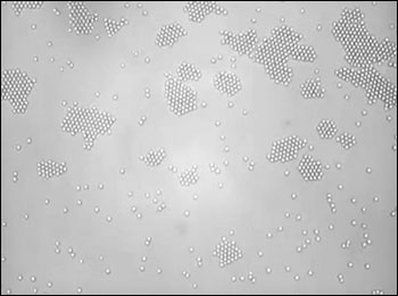
Researchers from Paul Chaikin's lab at NYU have made tiny, micron sized particles which can propel themselves through a catalytic chemical reaction. When moving, the particles undergo a phase transition which is very different from the passive case.
|
Bio-Material Based Active Matter
Check out the materials science approach which I used to innovate in active matter.